Get found
Can people identify your service from the page title and heading?

A clearer path from visitor to customer.
Get a free, prioritized website action plan: what the automated checks observed, what to fix next, and how to verify the change.
Free preliminary technical findings. No website login needed. A contextual review of your business is a separate, optional next step.
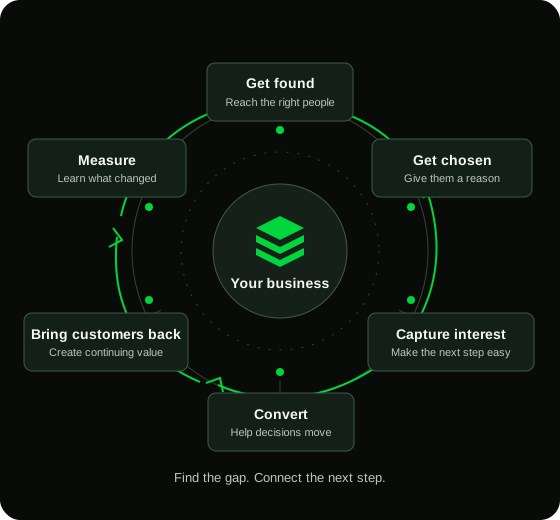
An unclear service page. A contact link that is hard to find. An estimate with no next step. Start with the question that sounds familiar.
The scan checks technical signals on your public page. Understanding what happens before and after an inquiry needs your business context and a separate review.
Can people identify your service from the page title and heading?
Does your page explain who you help and what to do next?
Is there an obvious way to ask a question or request a quote?
Who owns the reply, the estimate, and the next step?
When is a useful, welcome follow-up appropriate?
What evidence would show that a fix helped?
Example action plan · three illustrative fixes
These are example findings, not results from your website. Your priorities depend on the checks returned; a scan may find fewer issues or be unable to fetch a page.
Technical scope: reachability, HTTPS/TLS, metadata, headings, contact discoverability, and fetch timing. A single fetch does not establish visitor behavior, Google reviews, real-world page speed, or lost revenue.
Enter your website. The automated scan attempts to fetch the public URL and shows the technical observations it can make.
Read each finding alongside its evidence and verification step. Confirm anything the automated check could not establish before changing your site.
Optionally request a separate review of your customer path, goals, and existing tools. A request does not mean that review is complete.
Use the plan with your team, or discuss a scoped ROIzilla project. Check the change and agree how any business outcome will be measured.
Clarify the service, simplify the contact path, and test the handoff.
Define who replies, what happens next, and when a reminder should stop.
Plan relevant follow-up around customer needs and permission.
Choose a baseline and track agreed measures, from valid inquiries to booked work.
These are implementation goals, not scan results or promised gains. Technical checks can confirm a change; business outcomes need a baseline, connected data, and time to evaluate.
Explore solutions by outcomeWebsite scan
FreePreliminary technical findings and suggested next steps.Implementation projects
Around $5,000General guidance for a scoped project, not a fixed quote.Managed growth
From $1,500/moTypical starting guidance for agreed ongoing work.Advanced work
CustomComplex systems and multi-location requirements.All guidance is in USD. Final scope, fees, tool costs, media spend, usage, and terms require a proposal.
Keep what works.
Fix the part that needs attention.
Start with your existing website and tools. Any integration depends on access, compatibility, and the agreed scope; a rebuild is not the default.
It attempts to fetch a public website URL and checks reachability, HTTPS/TLS, metadata, headings, contact discoverability, and fetch timing. The action plan links observations to suggested fixes and verification steps. Content loaded by JavaScript or blocked from the fetch may not be visible to the checks.
No. Technical observations do not reveal lost revenue, conversion rates, or why a visitor left. Those questions need business context and suitable measurement. You can request a separate contextual review.
No. The scan reads a public page; it does not edit your website. You do not need to supply a website password, credentials, or customer records.
You can share your goals and contact details for a separate discussion. Saving a request is not a completed review or a promised response time. If you use the email option, you send the prepared draft through your own email application.
Yes. Use the suggested fixes and verification steps with your team. If you want ROIzilla to implement changes, the work and fees are agreed separately in a proposal.
Already know what you want to explore?
The interactive journey and optional examples below explain possible customer workflows. They are demonstrations, not findings about your business.
Explore the connected journey
Choose a phase, scroll through the journey, or take the optional guided tour. The example shows how the pieces fit together.
Eight phases · pause anytime.
Scroll or select a phase to explore ↓
Choose who to reach and test a message that speaks to their needs.
Optional example with made-up numbers. These are not client results or promised gains.
Finding: Broad targeting buys attention without proving intent.
Proposed work: Test audience × promise × surface. Compare delivered cost and qualified response before increasing spend.
Record delivery, spend and qualified response for each audience, creative and destination. Change one hypothesis at a time.
Record delivery, spend and qualified response for each audience, creative and destination. Change one hypothesis at a time.
Confirm the goal, ask what prevents the next step, explain the relevant option and agree a specific next action.
Context → finding → evidence → proposed change → owner → acceptance → next review.
Walk through the current stage, practice one exception, then complete the checklist with a reviewer.
How do we know the change helped? Compare qualified downstream outcomes against a predeclared baseline or experiment.
Correct context, permission, accurate information, complete handoff and attributable outcome.
Planning allocations are separate from the illustrative HUD assumptions.
Review the handoff and completion checks with your team before launch.
Explore capabilities for this work →Make your website easy to read, with clear services and a way to contact you.
Optional example with made-up numbers. These are not client results or promised gains.
Finding: The audience arrives, but the experience does not earn the next action.
Proposed work: Test the headline, proof, speed and CTA against engaged visits. Match the experience to the promise that brought the visitor.
Measure meaningful engagement and destination errors. Compare one message hypothesis across consistent audiences, then review downstream lead quality.
Measure meaningful engagement and destination errors. Compare one message hypothesis across consistent audiences, then review downstream lead quality.
Confirm the goal, ask what prevents the next step, explain the relevant option and agree a specific next action.
Context → finding → evidence → proposed change → owner → acceptance → next review.
Walk through the current stage, practice one exception, then complete the checklist with a reviewer.
How do we know the change helped? Compare qualified downstream outcomes against a predeclared baseline or experiment.
Correct context, permission, accurate information, complete handoff and attributable outcome.
Planning allocations are separate from the illustrative HUD assumptions.
Review the handoff and completion checks with your team before launch.
Explore capabilities for this work →Use a short form so requests reach your team with the details they need.
Optional example with made-up numbers. These are not client results or promised gains.
Finding: The ad makes a promise the landing page does not continue.
Proposed work: Match the page, offer and form to the message that earned the visit. Reduce friction without losing qualification.
Preserve campaign context. Ask only the fields needed for the next decision. Review form errors and lead quality.
Preserve campaign context. Ask only the fields needed for the next decision. Review form errors and lead quality.
Confirm the goal, ask what prevents the next step, explain the relevant option and agree a specific next action.
Context → finding → evidence → proposed change → owner → acceptance → next review.
Walk through the current stage, practice one exception, then complete the checklist with a reviewer.
How do we know the change helped? Compare qualified downstream outcomes against a predeclared baseline or experiment.
Correct context, permission, accurate information, complete handoff and attributable outcome.
Planning allocations are separate from the illustrative HUD assumptions.
Review the handoff and completion checks with your team before launch.
Explore capabilities for this work →Plan useful replies and reminders so the next step does not depend on memory.
Optional example with made-up numbers. These are not client results or promised gains.
Finding: Every prospect receives the same sequence regardless of their questions.
Proposed work: Sequence FAQs, proof, useful tools and remarketing by observed engagement. Allocate the next phase budget to supported opportunities.
Match the next asset to the unresolved question. Track permissioned account and contact signals; suppress opt-outs across sequences.
Match the next asset to the unresolved question. Track permissioned account and contact signals; suppress opt-outs across sequences.
Confirm the goal, ask what prevents the next step, explain the relevant option and agree a specific next action.
Context → finding → evidence → proposed change → owner → acceptance → next review.
Walk through the current stage, practice one exception, then complete the checklist with a reviewer.
How do we know the change helped? Compare qualified downstream outcomes against a predeclared baseline or experiment.
Correct context, permission, accurate information, complete handoff and attributable outcome.
Planning allocations are separate from the illustrative HUD assumptions.
Review the handoff and completion checks with your team before launch.
Explore capabilities for this work →Send the request to the right person, with notes and a clear next step.
Optional example with made-up numbers. These are not client results or promised gains.
Finding: Unowned callbacks let intent cool before anyone responds.
Proposed work: Assign an owner, response window and qualification script. Route to a person or approved workflow with context intact.
Check contact permission and channel preference. Capture need, fit, timing and the agreed next action. Honor stop requests.
Check contact permission and channel preference. Capture need, fit, timing and the agreed next action. Honor stop requests.
Confirm the goal, ask what prevents the next step, explain the relevant option and agree a specific next action.
Context → finding → evidence → proposed change → owner → acceptance → next review.
Walk through the current stage, practice one exception, then complete the checklist with a reviewer.
How do we know the change helped? Compare qualified downstream outcomes against a predeclared baseline or experiment.
Correct context, permission, accurate information, complete handoff and attributable outcome.
Planning allocations are separate from the illustrative HUD assumptions.
Review the handoff and completion checks with your team before launch.
Explore capabilities for this work →Connect the agreed work, invoice and payment so both sides know where things stand.
Optional example with made-up numbers. These are not client results or promised gains.
Finding: Accepted proposals stall between agreement, invoice and payment.
Proposed work: Clarify scope, price and terms. Connect the contract, checkout and invoice to one order record, then reconcile completion.
Confirm scope and terms before acceptance. Record invoice, payment and fulfillment independently. Recover failed transactions without duplicating charges.
Confirm scope and terms before acceptance. Record invoice, payment and fulfillment independently. Recover failed transactions without duplicating charges.
Clarify scope, payment timing, approval owners and handoff expectations before requesting commitment.
Order summary, payment-event map and transaction reconciliation checklist.
Walk through the current stage, practice one exception, then complete the checklist with a reviewer.
How do we know the change helped? Compare qualified downstream outcomes against a predeclared baseline or experiment.
Correct context, permission, accurate information, complete handoff and attributable outcome.
Planning allocations are separate from the illustrative HUD assumptions.
Review the handoff and completion checks with your team before launch.
Explore capabilities for this work →Use clear job steps and checks so the work is ready for the customer.
Optional example with made-up numbers. These are not client results or promised gains.
Finding: More orders cannot pass through a full delivery schedule.
Proposed work: Connect sales pace to available capacity. Install the delivery checklist, training, support and acceptance handoff.
Reserve capacity before promising dates. Track labor, materials, QA, acceptance and collections separately. Escalate exceptions.
Reserve capacity before promising dates. Track labor, materials, QA, acceptance and collections separately. Escalate exceptions.
Confirm the goal, ask what prevents the next step, explain the relevant option and agree a specific next action.
Context → finding → evidence → proposed change → owner → acceptance → next review.
Walk through the current stage, practice one exception, then complete the checklist with a reviewer.
How do we know the change helped? Compare qualified downstream outcomes against a predeclared baseline or experiment.
Correct context, permission, accurate information, complete handoff and attributable outcome.
Planning allocations are separate from the illustrative HUD assumptions.
Review the handoff and completion checks with your team before launch.
Explore capabilities for this work →Ask for honest feedback and plan useful contact when customers need you again.
Optional example with made-up numbers. These are not client results or promised gains.
Finding: Campaign reports stop at the sale, missing margin, retention and referrals.
Proposed work: Reconcile costs and outcomes. Compare cohorts and controlled experiments; version the winning SOP and reuse it where evidence supports fit.
Ask for honest feedback without gating reviews. Attribute referrals, compare contribution and test changes before promoting a new blueprint.
Ask for honest feedback without gating reviews. Attribute referrals, compare contribution and test changes before promoting a new blueprint.
Confirm the goal, ask what prevents the next step, explain the relevant option and agree a specific next action.
Context → finding → evidence → proposed change → owner → acceptance → next review.
Walk through the current stage, practice one exception, then complete the checklist with a reviewer.
How do we know the change helped? Compare qualified downstream outcomes against a predeclared baseline or experiment.
Correct context, permission, accurate information, complete handoff and attributable outcome.
Planning allocations are separate from the illustrative HUD assumptions.
Review the handoff and completion checks with your team before launch.
Explore capabilities for this work →Use the example to frame a real business question. Your scan findings will depend on the available evidence.
Get My Free Growth & Revenue ScanThese interactive examples use made-up numbers, not client results. Explore sample reports, forms and measurement tools. Your project will have its own agreed work and price.
A conversion change means little if the events are missing, duplicated or disconnected from revenue.
Finding: form submissions have no shared identity with the CRM handoff. An apparent lead drop could be a measurement defect.
Evidence needed: event payloads, duplicate counts, CRM receipts and reconciliation for the same reporting window.
Recommended work: map event IDs, fix deduplication, reconcile the CRM handoff and verify revenue linkage.
Review the handoff and completion checks with your team before launch.
Includes event dictionary, mapping, QA and one reconciliation review. Excludes paid media, historical data reconstruction and new channels. Two structured revision rounds; defects are corrected separately.
Find analytics, CRM and automation capabilities →Hypothesis: progressive qualification increases completed leads without lowering downstream quality.
Decision gate: valid randomization, predeclared sample, lead quality, contribution and no guardrail regressions.
Account → buying role → positioning → surface → next action. Compare the opportunity before allocating the next phase budget.
Learn which roles respond to which promise before concentrating spend.
Documented acquisition, delivery and retention reduce dependence on individual memory. That can support a more transferable business; enterprise value still requires business-specific financial evidence.
Where does revenue come from?
Where are you losing it?
Why is it happening?
What should change next?
Did the business get better?
Representative sequence: discover and baseline; analyze and prioritize; design; build and instrument; launch and validate; measure and hand off. A six-week sprint is one planning template, not a universal delivery promise.
Agree deliverables, access, dependencies, revision rounds, stabilization period and acceptance criteria before work begins. Additional funnels, brands, channels or integrations become separately scoped change requests.
Add your website or a short description of your idea. We’ll help you carry it into an email-ready request.
The request is reviewed by our team after you choose to email it.
One website. A clearer next step.
Start with what can be observed. Get a prioritized website action plan, then decide what deserves your time.
Check my websiteFree technical scan. Optional contextual review. Implementation by proposal.